

The CahowCam 1&2 nesting pairs and their offspring, are arguably the rarest, most-studied, non-captive seabirds on the planet!
CahowCam1 male 57,000 mile tracks April 2009-June 2010
Along with the 24/7 CahowCam LiveStreams that over the past 14 years have revealed their intimate and at times surprising nesting behaviours, which in turn triggered recent genomic paternity tests, our Bermuda Petrel Biomonitoring Project collaboration is revealing where first the adults and now the chicks spend their time on the high seas. Read about Jeremy’s recent recovery of a chick from CahowCam2, followed by 15 month 57,000 miles of tracks from the CahowCam1 male when we was tagged back in 2009/2010.
Jeremy Madeiros: “November and early December were busy during the courtship and nest-building period of our endemic and critically endangered Cahow, or Bermuda petrel. Due to the small population size and very limited breeding area of the Cahow, it has been possible to follow individual birds that I fitted with i.d. bands as long ago as 2002, permitting us to follow the lives of individuals in some cases for 23+ years.
The most exciting of these are what I call "known-age birds", that is, Cahows banded as chicks in nests, so that we know their parents, nesting island and nest number that they originated from, including the dates that they fledged. You can then follow these birds for the rest of their breeding lifespan.
Totoro with GLS tag after 3 years at sea
One group of fledglings in particular that I have been looking out for are those that fledged during the 2021-2022 breeding season. That is because I fitted 37 fledglings that year with GLS tags provided by research partner Letizia Campioni, that were capable of recording & archiving daily position fixes for periods of more than 2 years. This should solve the mystery of whether the fledglings go to the same oceanic areas that the adult birds do, during the period where the young Cahows spend the first 3 to 5 years of their lives before they return to look for nest sites and mates,
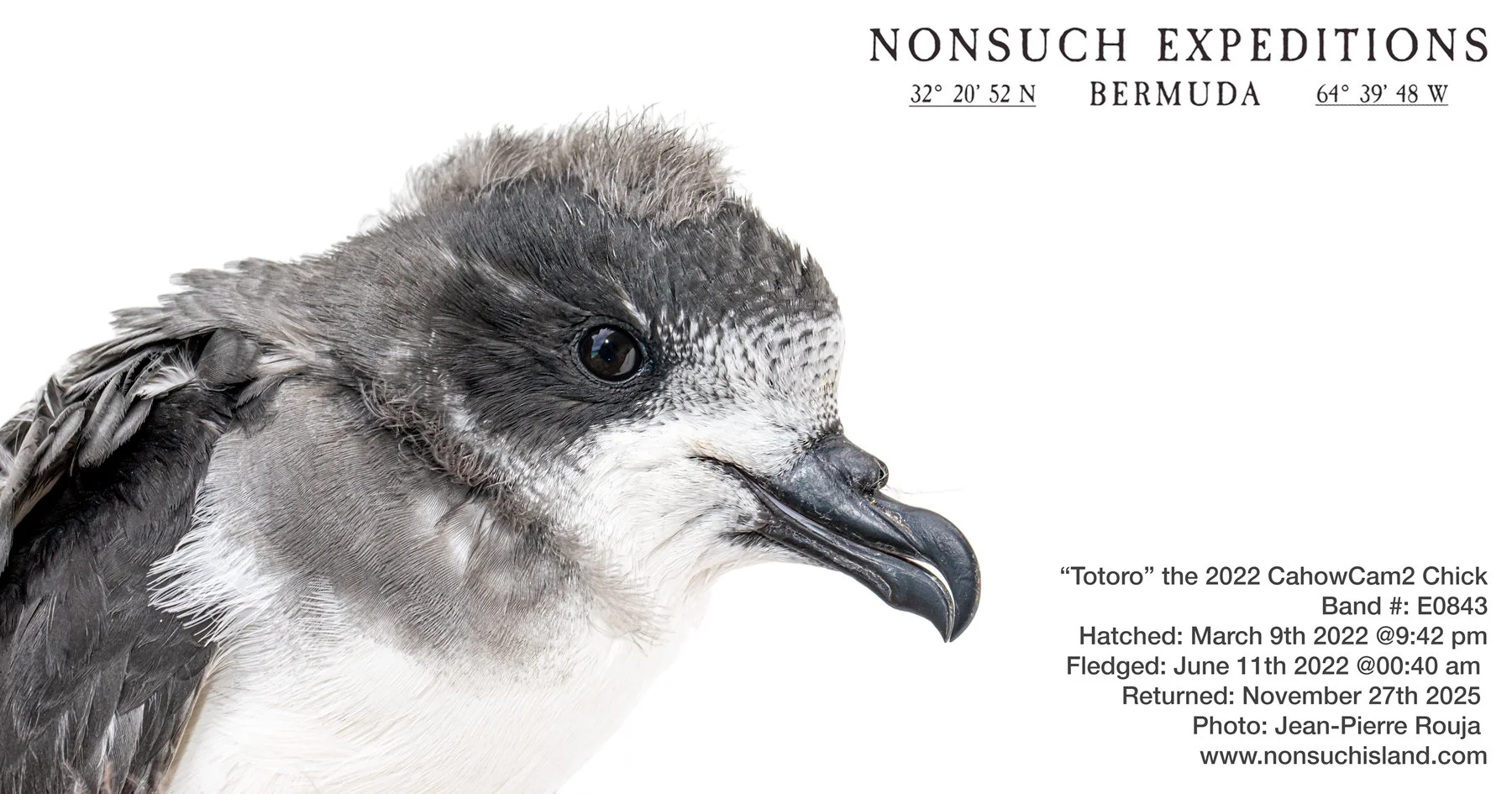
On Nov. 27th, 2025, I was able to confirm the 1st-return of a chick from this 2022 chick cohort, when I captured a young prospecting male Cahow in the Nonsuch R825 nest. After checking it's band/ring number (E0843), it turned out to be "TOTORO", the 2022 chick from the CahowCam2 nest (nest no. R832), which was fitted with a GLS tag no. CE326 in June 2022. As it turned out, J.P. Rouja filmed & photographed me fitting the tag to the chick, which can be seen below. Also included are a photo of the now-adult "Totoro", and another of me detaching the tag, which will be given to Letizia to extract possibly 2 years of locational data, which can hopefully fill in the gap in knowledge of where young Cahows go during the "lost years" period before they mature and return to the breeding islands to prospect for nest burrows and mates.
Hopefully, we will find additional tagged Cahows from this group later this season and through the next couple of years. It is always a thrill to find out which of my adopted "feathered foster children" have survived their lost years and returned to start their own legacy. All the best!”